
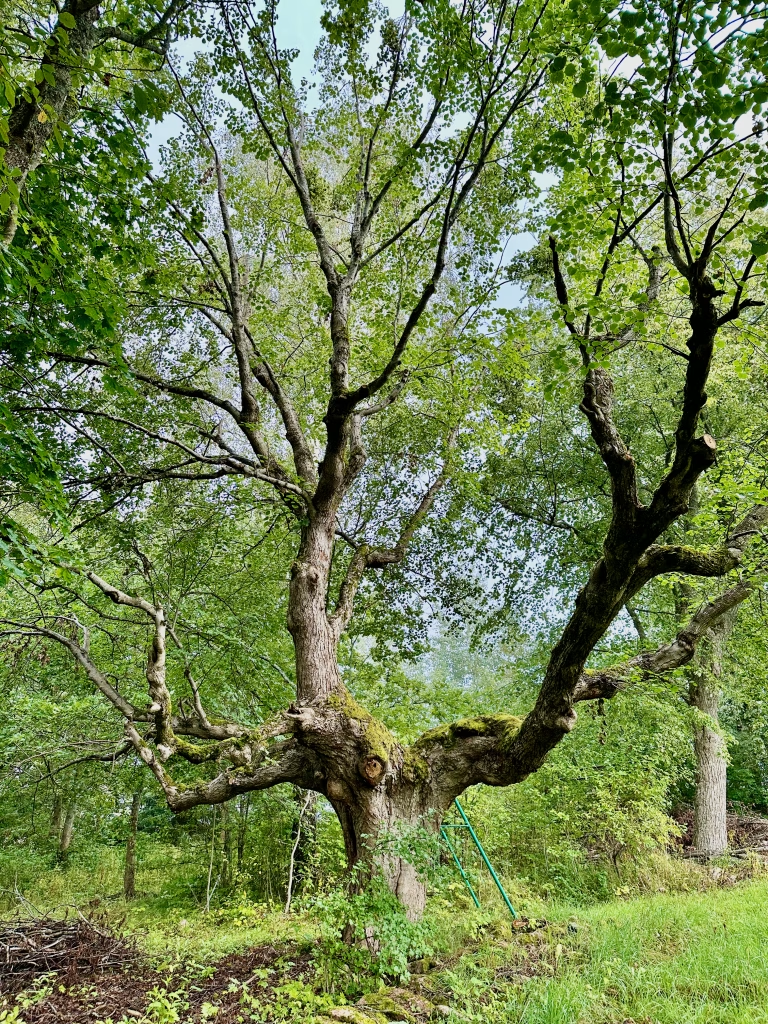
In the beginning, there was the forest. Then, humans cleared it for fields, pastures, and a productive garden. Now, we are thoughtfully and delicately restoring it back into a functioning ecosystem, an arboretum.
The boundary between a garden and a forest is often defined too strictly. At Ilopakka, that boundary does not exist. The 1.5 hectares spreading around the century-old house is not a traditional, meticulously manicured display park. It is a living, breathing, and continuously evolving arboretum – a place where nature’s own processes are allowed to be seen, heard, and smelled.
A historical foundation
At the heart of the area beats a rich and documented variety of species. Currently, around 50 different woody species grow on our grounds. Old, sturdy deciduous and coniferous trees, a historical apple orchard, and an oak grove planted in the 1990s form the backbone of the arboretum.
Mature deciduous trees are not merely an aesthetic element; their expansive canopies create a protective shelter over the yard. The shade cast by the leaves and the moisture they transpire create a cooling microclimate, which is easy to appreciate during midsummer heatwaves.
The setting is dendrologically fascinating, and it is upon this foundation that we are building the story of the coming decades.
Ecological restoration and the ArbNet goal
Sustainability and ecology are often mere buzzwords in the modern travel industry. We wanted a measurable and scientific framework for our vision. That is why we are developing the area toward official accreditation from the international ArbNet arboretum network.
ArbNet status does not mean restrictive interference with nature’s choices, but rather understanding and supporting them. We call this our semi-wild philosophy. We do not fight against nature, but subtly guide its development. This is modern, transparent nature conservation.
We actively support the ecological restoration of the Ilopakka area: decaying wood is intentionally left in place to provide habitats for insects and birds. The undergrowth is allowed to flourish where it naturally thrives.
A living and renewing collection
Our arboretum is not a static tree museum, but a continuously evolving ecosystem. Thanks to the area’s favorable microclimate and rich soil, our noble deciduous trees regenerate naturally on the grounds.
The oak grove acts as a sheltered nursery not only for new oaks but also for lindens, which can successfully reproduce there from seed. It is also fascinating to observe how the seeds of ash trees growing slightly further away find their optimal germination spot right in the shade of the oaks.
The delicate layer of spring 2027: Azaleas
An arboretum is never finished; it is a project that spans generations. We continue to build the area’s biodiversity and visual layering with thoughtful steps. In 2023–2024, we planted Ilopakka’s first hazelnut shrubs and walnut trees, a magnolia, and a couple of European hornbeams.
In the spring of 2027, the plan is to plant a dozen azaleas at Ilopakka. They have been selected not only for their hardy nature but also for their delicate aesthetics. When the azaleas bloom in the shade of old, shield-barked pines, a strong visual contrast is created. It brings a colorful layer to the lush peace of the small coniferous grove, making spring and early summer here truly worth experiencing.
Future plans involve taking advantage of the effects of a warming climate and rising annual heat sums. Our list of woody plants to trial includes at least the European beech (Fagus sylvatica), sweet chestnut (Castanea sativa), apricot (Prunus armeniaca), and more exotic magnolias.