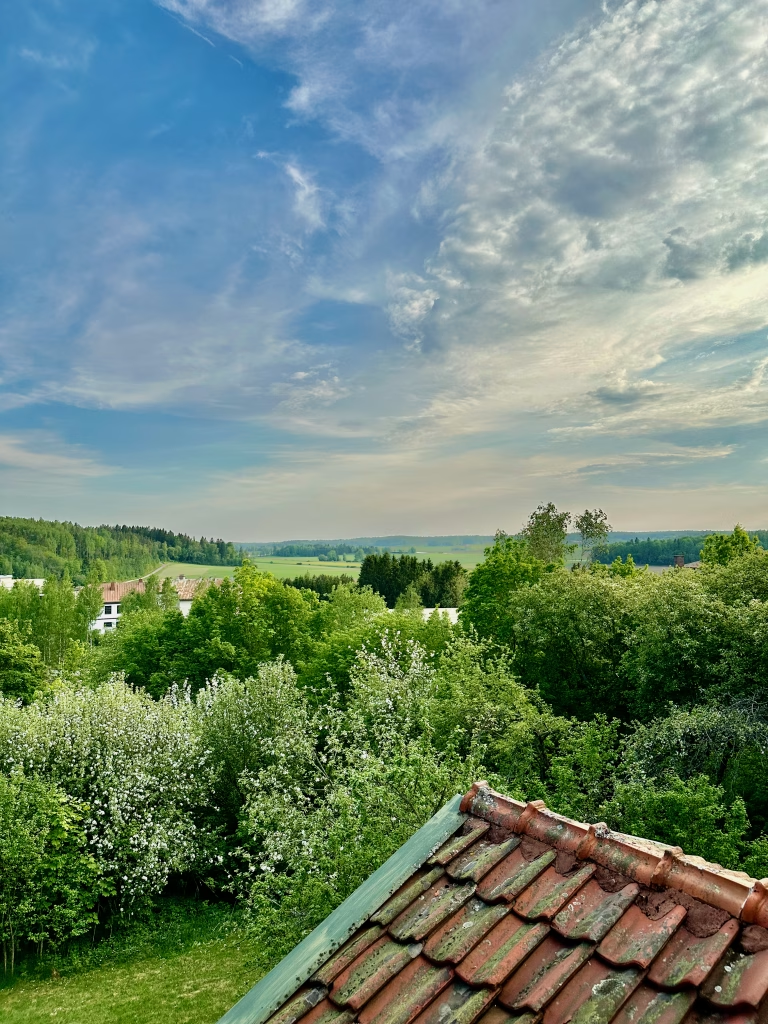
The hill of Ilopakka descends into the Perniönjoki river valley as a serene slope. The fields down on the flatland are the color of old rope. A row of deciduous trees follows the river, and low, forested ridges roll in layers toward the horizon.
Early in the morning or during the long shadows of a spring afternoon, it is genuinely hard not to think of Tuscany. But is there any truth to this association with central Italy? In reality, not much. But a closer comparison is absolutely worth the effort.
Two cradles of culture, two different trajectories
During the Bronze Age, the regions of Perniö, Uskela, and Halikko were in a completely different geographical and topographical phase than today. Due to post-glacial land uplift, the sea level during the Bronze Age was about 15–20 meters higher than it is now. The present-day vast open fields and river valleys were sheltered sea bays at the time, and high rocky hills formed the landmarks of the archipelago and the coast.
The Perniö area, especially the Asteljoki river valley, forms one of the most significant concentrations of Bronze Age settlement in Southwest Finland. The rocky hills rising from the sea and the lush river valleys provided an ideal setting for agriculture, fishing, and the construction of monuments.
Leuarinmäki, located in Suomenkylä, Perniö, represents the pinnacle of Bronze Age monumental architecture in the area. On a high rocky hill rising amidst the fields, there are five separate cairn monuments. The two large burial cairns on the hill are among the most magnificent in Southwest Finland in terms of their proportions, and they dominate the surrounding landscape of the Asteljoki valley. To the west of Leuarinmäki are the two burial cairns of Alhainen, which complete the picture of this extensive burial area. To the southwest of Leuarinmäki rises the rocky hill of Ritanummi, home to four cairns. This concentration of monuments indicates that the Asteljoki valley was a significant center of power for several generations.
The regions of Perniö, Uskela, and Halikko, together with the Kokemäenjoki river valley, the Åland Islands, and the Aurajoki river valley, formed the core of the Bronze Age culture on the Finnish coast, which adopted its influences directly from Scandinavia.
The Bronze Age monuments and settlements of the area were the necessary foundation for the wealth and social hierarchy that enabled the subsequent, nationally exceptionally rich development of Iron Age and medieval history.
The story of Etruria begins in roughly the same time window.
The Apennine culture, which inhabited Tuscany during the Late Bronze Age, dates from about 1350–1150 BC, followed by the Villanovan culture of the Early Iron Age from about 1100–700 BC – both periods overlapping with Finland’s own Bronze Age, traditionally placed between 1700–500 BC. In other words, for several centuries, something similar was happening in both landscapes: they were filling with settlements, rituals, and burial monuments.
Then the paths diverged completely. The actual Etruscan culture spread across the Tuscany region from the 8th century BC onwards, reached its peak in the 7th and 6th centuries BC, and built city-states, a written language, and a tradition of art and engineering.
Rome absorbed the achievements of the Etruscans and eventually swallowed all of Etruria by the 1st century BC. There is nothing comparable in Finland before the Middle Ages.
It is clear that Bronze Age Perniö was not the Etruria of the North. Both were centers of cultural development for their time and region. The more southern one developed much further and much faster.
A nationally valuable landscape
Southwest Finland has been called the granary of Finland, and the reason is visible from the hill of Ilopakka: vast fields open up between rocky, forested knolls, cultivated for hundreds of years.
The farmlands spreading along the Perniönjoki river – together with the adjacent valleys of the Halikonjoki and Uskelanjoki rivers – have been designated as a nationally valuable landscape area.
Tuscany’s economy tells a parallel story in a different climate. It has long been one of Italy’s most productive agricultural regions, and even the wealth of the Etruscans relied heavily on fertile land and advanced farming methods, alongside mining and trade.
Two valleys that have been cultivated continuously for a very long time, and both of which have played a central role in feeding their respective parts of the country.
Light and terrain
In the photograph at the top of the page, the light bends in a special way. At these latitudes, the sun’s trajectory meets the horizon at a shallow angle, stretching the sunrise and sunset into long, slow transitions. To the eye of someone who has lived or traveled in Italy, this honeyed, low-shining glow looks unmistakably Tuscan.
Tuscany’s famous light is created by a different mechanism: dry air and fine dust scatter sunlight at the warm end of the spectrum, a phenomenon that painters have chased since the Renaissance.
Two landscapes known for their beautiful light. Two completely independent phenomena of physics.
The similarly rolling terrain is an even more interesting phenomenon, as the resemblance is real, but the explanation is almost the exact opposite.
Viewed from above, river valleys and ridges alternate in a similar rhythm in both landscapes. Descriptions of the Salo terrain sound almost like a translation of the Tuscan countryside: fields weaving between forested, rocky highlands.
But these two landscapes were built as a result of opposing processes and on opposite timelines.
The hills of Tuscany are the edge of the Apennine Mountains, which have risen as a result of the slow collision of tectonic plates over the last 65 million years or so. The most intense uplift occurred between about 23 and 2.6 million years ago. The age of the landscape is still measured in geological eras.
By comparison, the Perniönjoki valley is unfinished. Just 10,000–12,000 years ago, it rested under an ice sheet miles thick.
The retreating ice carved, sifted, and piled every ridge and depression in sight in the span of only a few hundred human generations. And the earth still hasn’t stopped moving. This part of Southern Finland is still rising from the sea at a rate of about 3–5 millimeters per year.
When you stand on the hill of Ilopakka, the sensation of Tuscany is real for a moment. Then it gives way to something even more fascinating: a landscape that looks eternal, but geologically speaking, is only just being born.