
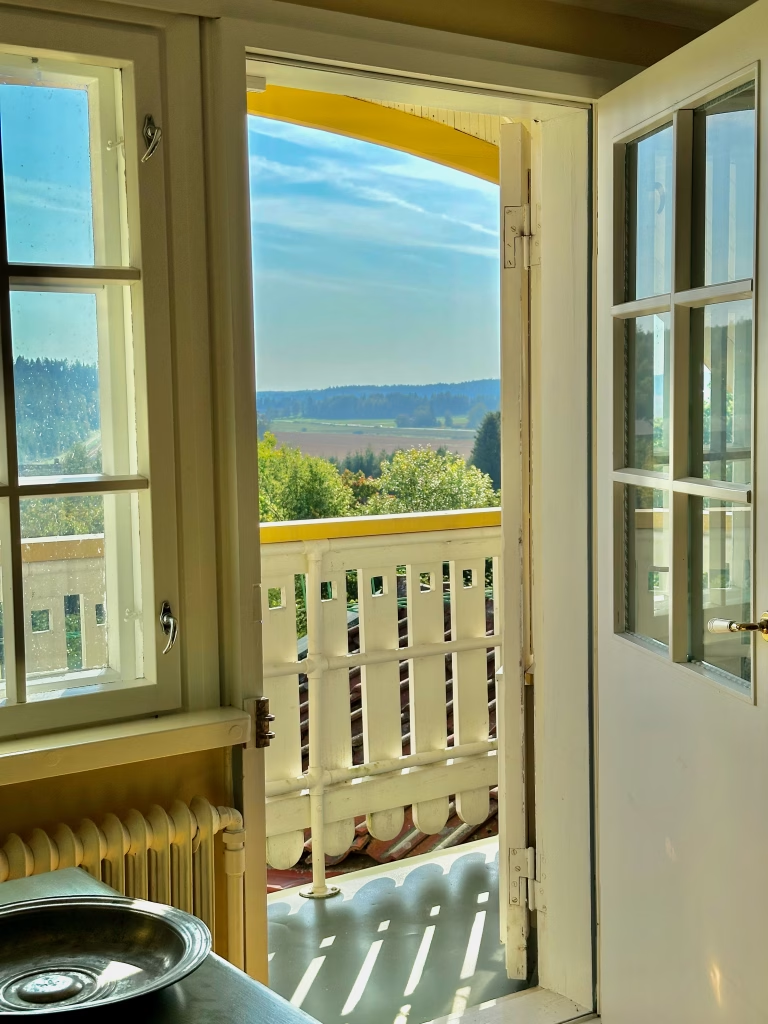
Before Ilopakka was anything else, it was likely a swing. According to local lore, the hill rising above Paarskylä’s old working-class district was a gathering place for the village youth – and there stood a large wooden swing, built for a crowd rather than a single person.
The word ”ilo” means exactly that – joy; ”pakka,” in turn, is a corruption of the Swedish word ”backe,” meaning a hill or slope. When the words are combined, the name is a direct description: Ilomäki, Joy Hill. This is the best available explanation for the name’s origin.
The Stationmaster’s house
The origins of the log house that now bears the name are better documented. Stationmaster Arttur Ahola – born Halenius – built it between 1912 and 1913 for his own family because he could not find a rental apartment through his employer, the State Railways. Ahola built only the bare necessities: a main room and a bedchamber. It was, as was customary at the time, a small croft on rented land without arable fields, a typical dwelling for Finland’s landless rural working class.
In the late 1910s, the Aholas moved to an apartment owned by the railways and rented out their small house. In the early 1920s, Filemon Fulgentius Kaarlonen of the Paarskylä manor acquired the house – and Ilopakka became a sub-estate of Paarskylä.
The manor in the valley
Paarskylä manor is one of Perniö’s old rusthollari estates – a cavalry estate exempted from taxation in exchange for equipping a cavalryman for the crown. Over the centuries, its owners have included the noble Gyllenhierta and Ramsay families, and in the late 19th century, the Mannerheim family.
In 1866, as part of the von Julin family’s inheritance distribution, Hedvig Charlotta ”Hélène” von Julin inherited the Paarskylä manor in Perniö. The following summer, she gave birth to her third child, Carl Gustaf Emil Mannerheim – the future Marshal of Finland.
Hélène retained possession of Paarskylä until her death (January 23, 1881), which means the manor belonged to the Marshal’s own mother throughout his entire childhood. Local lore tells that the young Carl Gustaf spent time in Paarskylä and played in the courtyard of the manor situated in the valley.
In 1901, ownership of Paarskylä transferred to Filemon Fulgentius Kaarlonen. His family has held the estate ever since. It was this very Kaarlonen who, two decades after taking over the manor, bought the small stationmaster’s house on the hill and expanded it.
Briefly a school
The Kaarlonens lived at Ilopakka for about fifteen years until the mid-1930s, and for part of that time, the house operated as a school. Perniö did not have a permanent secondary school when Kaarlonen’s own children reached school age, so he founded a private preparatory school.
Perniön Yhteiskoulu Oy operated first in a bank building and then, from 1921 onwards, in his own home. The upper floor of Ilopakka housed a classroom and the teacher’s apartment. The Perniö co-educational school received its official founding permit in 1927 and moved to a purpose-built school building in 1929.
War, repairs, and new owners
Ownership changed again in the mid-1930s when Paarskylä’s estate manager, Oskar Mattila, moved into the house with his family as the Kaarlonens returned to the main manor building.
It was Mattila who expanded the building to roughly its current form. During Mattila’s time, the house was known for its carefully tended garden and sand pathways. During the wars of the 1940s, it also provided shelter for Karelian evacuees. Oskar’s son Eino Mattila continued the repair work until the 1960s.
Written into national memory
The Finnish Heritage Agency has designated the manors and agricultural landscape of the Perniönjoki river valley, along with the adjacent Perniö station area, as a nationally significant built cultural environment. The Paarskylä manor, its old station village, and Ilopakka, situated on the hill above them, are part of the same cultural-historical story – both on paper and in people’s memories.
Everything started on a slope where the village gathered to swing and spend time. A stationmaster built a home for his family there because there was nowhere else to live. A count’s daughter – who happened to be the mother of Finland’s most famous soldier – once owned the manor in the valley. A school began operating on the upper floor. Evacuee families found shelter in the house’s many rooms. Over a century later, Ilopakka continues to do roughly what it has always done: welcome people.